
24 Sep Preserving What Can’t Be Written Down: A Look at PRISM for Culture Collections
A New AI-powered Tool Turns Lab Recordings into Structured Protocols
By JooHee Choi – Cultivarium
The Problem with How We Document Lab Work
Any microbiologist who has spent time with an unusual organism knows there is a version of the protocol that is written down, and a version that actually works. The written version lists reagents and incubation times. The working version includes the moment you learned to tilt the inoculation loop just so, to watch for that particular haze that tells you the culture is ready. This tacit knowledge – accumulated through failure, passed on through mentorship, and lost when people leave – is the true intellectual heritage of a culture collection.
At Cultivarium, a nonprofit research organization dedicated to expanding the genetic toolkit across non-model microorganisms, we confront this problem daily. Our work requires onboarding new strains at scale: testing media compatibility, revival conditions, and transformation approaches across hundreds of organisms, many of which have no published protocols. We also work with academic labs, industry contacts, and consortium partners who need to reproduce our methods remotely.
Our first attempt to solve this was “lab lore” on the Cultivarium Portal: a structured post where any user can document organism-specific quirks, workarounds, and hard-won insights. But it still depended on someone taking the time to write things down after the fact, translating a physical, tacit experience into text. And text, however detailed, cannot capture the tilt of a pipette or the timing of a reaction.
Introducing PRISM
PRISM (Protocol Recording for Improved Scientific Methodology) is our answer to that gap. It is a video-based documentation tool that uses vision-language models to watch a scientist work and automatically generate a structured, annotated protocol from the footage. The scientist dons camera glasses and conducts their work as usual. PRISM handles the rest: transcribing, identifying key protocol steps, and producing a shareable video protocol.
The result is documentation of what actually happened in the lab. And the benefits compound: new team members get up to speed faster, methods are preserved when people leave, remote collaborators can troubleshoot against a ground-truth record, and institutional knowledge accumulates over time. To date, over 33 labs worldwide have adopted PRISM for reproducible methods for not just microbiology but also bioengineering, materials science, and microfluidics.
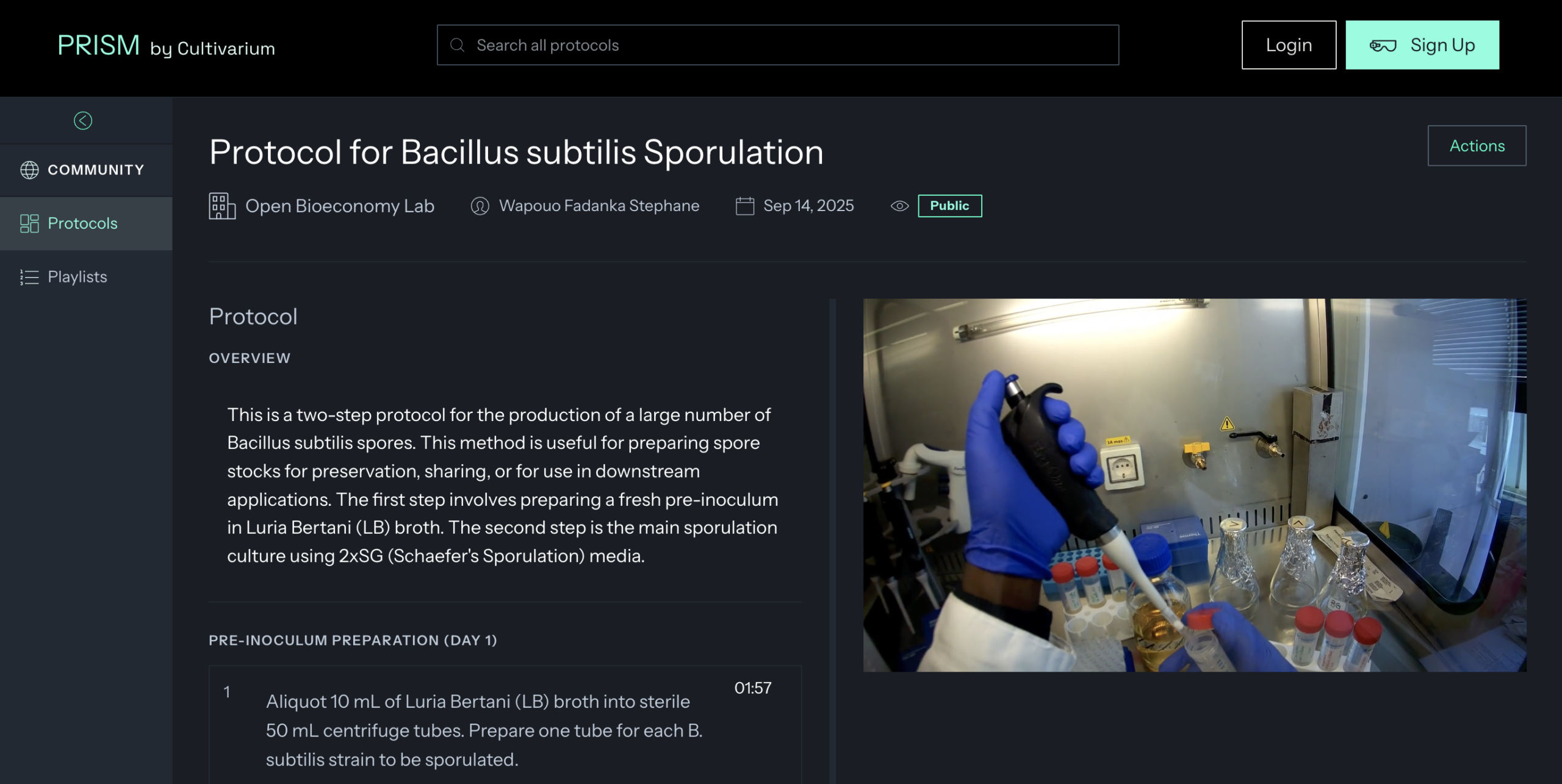
Example PRISM video protocol | Image credit: Cultivarium
PRISM for Culture Collections
Culture collections present a particularly compelling use case. Many collections hold thousands of strains, each with a history of handling, revival, and quality control practices that lives partially in written Standard Operating Procedures (SOPs), and partially in the heads of experienced staff. PRISM can help capture a wide range of workflow expertise, including:
Preservation
Cryopreservation and lyophilization protocols vary in their details: glycerol concentration, fill volume, the specific handling required for organisms that aggregate or clump. PRISM-recorded preservation runs create a visual reference for each protocol variant, making it possible to compare approaches across strains, audit for drift over time, and bring new staff up to the exact method in use rather than a generic procedure.
Revival
Revival is often the highest-stakes moment in a collection workflow: the step where accumulated variation between what is written and what is done becomes consequential. PRISM recordings of revival procedures, particularly for fastidious or slow-growing strains, give collection staff a benchmark against which to evaluate new attempts. They also make it easier to diagnose why a revival is failing: is the incubation too long, the medium wrong, or is this just what this organism does for the first 48 hours?
Quality Control (QC)
QC procedures- colony morphology checks, purity assessments, growth curve validations- involve a substantial element of expert judgment that is difficult to standardize in text. What does “normal” look like for a strain that produces spreading colonies, or exhibits both smooth and rough morphotypes? PRISM recordings of accepted QC outcomes give scientists a concrete reference standard, making it possible to flag genuine deviations rather than normal variation.
User Story: PRISM at the ECRC
The E. coli Reference Center (ECRC) at The Pennsylvania State University is the largest repository for E. coli strains in the United States, housing more than 90,000 strains collected over the past 50 years. The center has sequenced and made publicly available the genomes of over 8,000 isolates, supporting global research on foodborne pathogens and microbial pathogenicity. We worked closely with ECRC Director Ed Dudley to deploy PRISM in his lab.
Following a brief onboarding call, PhD student Anna Acosta filmed and uploaded two videos: a DNA Extraction protocol and an NCBI sequence submission protocol. The first demonstrates DNA extraction from an overnight culture. Although the video contains no narration, PRISM matched the accompanying protocol text to the relevant timestamps in the recording. In the second video, Anna walks through sequence submission steps at her computer. Using her narration, PRISM generated a detailed, step-by-step protocol from the video. Both videos are publicly available to view.
ECRC DNA Extraction Protocol | Image credit: Cultivarium
ECRC NCBI Sequence Read Archive Submission Protocol | Image credit: Cultivarium
Getting Started with PRISM
All you need to get started is a video. At Cultivarium, we use camera glasses for hands-free recording, but several collaborators have recorded their first PRISM protocols with a phone. Upload a video to PRISM, and the platform generates a structured video protocol ready for review. Protocols can be shared privately with collaborators in a workspace or published as public resources. Watch the demo video to learn more about PRISM’s features.
For collections beginning to explore PRISM, we recommend starting with a high-value procedure that varies substantially across users or depends on experiential knowledge- for example, reviving a particularly difficult strain or performing a QC step that relies on experienced-eye judgment. Your first recording can serve both as useful documentation and as a practical test of how PRISM fits into your existing workflows.
Try PRISM
Ready to turn your team’s know-how into reusable protocols? Create a free PRISM account and upload your first video today.
- Create a free account
- Watch the PRISM demo
- Explore public protocols
- Contact us about a pilot or collaboration